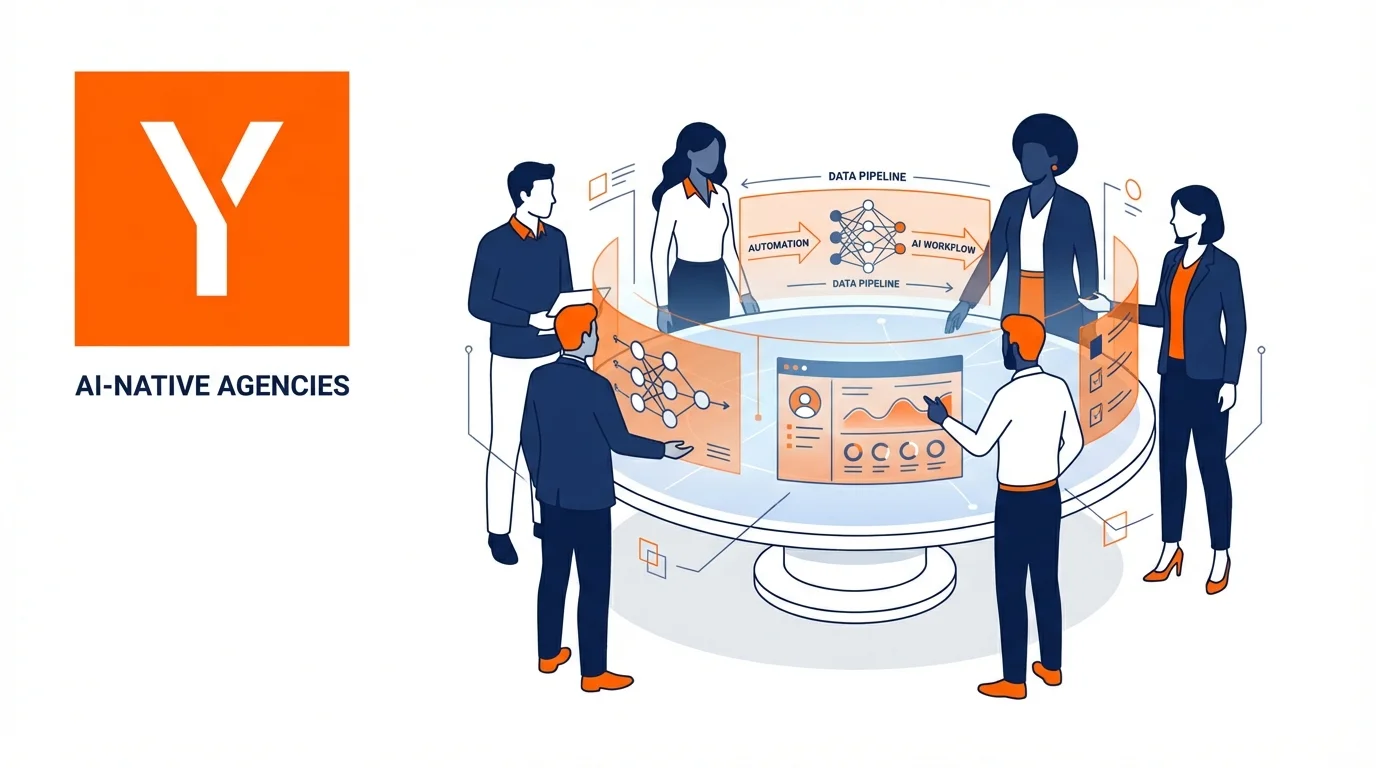
Y Combinator, le plus prestigieux accélérateur de startups au monde, l'a annoncé clairement dans ses « Requests for Startups » 2025-2026 : ils recherchent des AI-Native Agencies. Ce signal est sans précédent. Quand l'incubateur qui a lancé Airbnb, Stripe et Dropbox décide que le modèle d'agence traditionnelle est mûr pour une disruption par l'IA, c'est que le basculement est déjà en cours.
Mais qu'est-ce qu'une AI-Native Agency exactement ? En quoi diffère-t-elle d'une agence qui « utilise l'IA » ? Et surtout, comment ce modèle redéfinit-il la création de valeur pour les entreprises clientes ? Ce guide est le plus complet que vous trouverez en français sur le sujet.
À retenir
- ▸Une AI-Native Agency reconstruit toute sa chaîne de valeur autour de l'IA. Utiliser ChatGPT sur des processus inchangés ne suffit pas : modèle économique, structure d'équipe et workflows doivent être repensés dès la conception.
- ▸Y Combinator a inscrit les AI-Native service companies dans ses Requests for Startups 2025-2026. L'accélérateur considère le modèle d'agence traditionnelle comme mûr pour une disruption par l'IA.
- ▸Le test décisif est la facturation. Une agence qui facture au TJM reste une agence classique qui utilise l'IA ; une AI-Native Agency facture à la valeur ou au résultat.
- ▸La revue humaine systématique n'est pas négociable. Tout livrable passé par l'IA est validé par un expert avant envoi : un incident (hallucination publiée, fuite de données) détruit la confiance en quelques heures.
- ▸Cinq questions démasquent le « AI washing » : part IA vs humain dans le livrable, mode de facturation, garde-fous contre les hallucinations, confidentialité des données (RGPD), et démonstration d'un workflow IA de bout en bout.
Dans cet article
- 1. Qu'est-ce qu'une AI-Native Agency ? Définition
- 2. Le signal Y Combinator : pourquoi maintenant ?
- 3. AI-Native Agency vs agence traditionnelle
- 4. Les 7 piliers d'une AI-Native Agency performante
- 5. Études de cas : 3 modèles qui fonctionnent
- 6. La stack technologique d'une AI-Native Agency
- 7. Comment devenir (ou choisir) une AI-Native Agency
- 8. Les 5 erreurs fatales à éviter
- 9. JAIKIN : une AI-Native Agency européenne
- 10. FAQ
Vous cherchez une AI-Native Agency ?
Réservez un appel de 30 min avec un expert JAIKIN. On évalue ensemble comment l'approche AI-Native peut transformer vos opérations.
Parler à un expert →1. Qu'est-ce qu'une AI-Native Agency ? Définition précise
Une AI-Native Agency (agence IA-native) est une entreprise de services dont l'intelligence artificielle constitue le fondement architectural de son modèle opérationnel — et non un simple ajout à des processus existants. L'IA n'est pas un outil parmi d'autres : c'est le système nerveux central de l'organisation.
La nuance est capitale. Beaucoup d'agences aujourd'hui « utilisent l'IA » : elles ont adopté ChatGPT pour rédiger des briefs, ou Midjourney pour générer des visuels. Mais leur modèle économique, leur structure d'équipe et leurs processus restent identiques à ceux d'une agence traditionnelle. Une AI-Native Agency, en revanche, a re-pensé sa chaîne de valeur entière autour des capacités de l'IA.
Agence « IA-augmentée » (la majorité)
- Utilise l'IA comme un outil ponctuel
- Même modèle économique (facturation au temps)
- Même taille d'équipe pour le même scope
- L'IA accélère certaines tâches, sans les transformer
- Le client paie pour du temps humain
AI-Native Agency (le nouveau modèle)
- L'IA est intégrée dans chaque processus dès la conception
- Modèle économique basé sur la valeur délivrée
- Équipes réduites à forte expertise (×3 à ×10 de levier)
- Workflows automatisés de bout en bout
- Le client paie pour des résultats mesurables
Concrètement, une AI-Native Agency peut délivrer un projet qui nécessiterait 10 personnes dans une agence classique avec une équipe de 2 à 3 experts. Non pas parce que le travail est bâclé, mais parce que les workflows, l'analyse de données, la génération de contenu, les tests et le déploiement sont orchestrés par des systèmes d'IA spécialisés, supervisés par des humains experts.
Définition JAIKIN : Une AI-Native Agency est une organisation de services qui conçoit ses processus, son modèle économique et sa structure autour de l'IA dès le premier jour — plutôt que de greffer l'IA sur un modèle existant. Le résultat : un ratio valeur/coût radicalement supérieur pour le client.
2. Le signal Y Combinator : pourquoi maintenant ?
Y Combinator (YC) publie régulièrement ses « Requests for Startups » (RFS) : une liste de secteurs et modèles dans lesquels l'accélérateur souhaite investir. Fin 2025, pour la première fois, YC a explicitement inclus les AI-Native service companies — un signal fort envoyé à l'écosystème tech mondial.
Ce que YC a écrit (et ce que ça signifie)
« AI-powered service businesses can now deliver 10x the output with a fraction of the headcount. We're looking for founders who are building the next generation of agencies — ones where AI is the default, not an add-on. » — Y Combinator, Requests for Startups 2025
Derrière cette déclaration, YC identifie trois tendances de fond qui rendent le modèle AI-Native Agency viable maintenant (et pas il y a deux ans) :
Les LLM sont devenus fiables
Claude Opus 4.6, GPT-4.1, GLM-4, Gemini 2.5 Pro atteignent des niveaux de qualité qui surpassent les experts humains sur de nombreuses tâches. Le gap entre « intéressant » et « supérieur à l'humain en production » est comblé (source : notre guide IA générative).
Les agents IA fonctionnent
Les architectures d'agents IA multi-étapes (planification, exécution, vérification) permettent d'automatiser des workflows complets, pas juste des tâches isolées.
Le coût a chuté de 95 %
Le coût par token des LLM a été divisé par 20 entre 2023 et 2026 (source : Andreessen Horowitz, « AI Pricing Trends », 2025). Ce qui coûtait 100 $ en infra IA en 2023 coûte 5 $ aujourd'hui.
Le marché mondial des services IA explose
Les chiffres confirment l'intuition de YC. Selon Grand View Research, le marché mondial des services d'IA devrait atteindre 621 milliards de dollars d'ici 2028, avec un taux de croissance annuel de 37,3 %. McKinsey estime que l'IA générative seule pourrait ajouter 2 600 à 4 400 milliards de dollars de valeur à l'économie mondiale chaque année (source : McKinsey, « The Economic Potential of Generative AI », 2023).
Le message est clair : les agences qui ne passent pas au modèle AI-Native risquent d'être « dévorées » par celles qui le font. C'est exactement ce que YC anticipe en investissant dans ce créneau.
3. AI-Native Agency vs agence traditionnelle : le comparatif détaillé
Pour bien comprendre la rupture, comparons les deux modèles sur 8 dimensions clés :
| Dimension | Agence traditionnelle | AI-Native Agency |
|---|---|---|
| Modèle économique | Facturation au temps (TJM) | Facturation à la valeur / au résultat |
| Taille d'équipe projet | 5–15 personnes | 2–4 experts + agents IA |
| Délai de livraison | Semaines à mois | Jours à semaines |
| Scalabilité | Linéaire (plus de clients = plus de recrutements) | Exponentielle (l'IA scale sans recrutement) |
| Marge opérationnelle | 15–25 % | 40–70 % |
| Personnalisation | Templates + personnalisation manuelle | Hyper-personnalisation automatisée via données |
| Qualité du livrable | Variable (dépend de l'équipe affectée) | Constante (pipelines standardisés + revue humaine) |
| Données et reporting | Reporting manuel, périodique | Dashboards temps réel, IA prédictive |
Point clé : le différentiateur n'est pas la technologie elle-même, mais la refonte complète du modèle opérationnel. Utiliser ChatGPT pour rédiger plus vite ne fait pas de vous une AI-Native Agency — repenser la chaîne de valeur du brief à la livraison, si.
4. Les 7 piliers d'une AI-Native Agency performante
Après avoir analysé les startups YC et les agences les plus innovantes du marché, nous avons identifié sept piliers structurants qui distinguent les AI-Native Agencies qui réussissent de celles qui échouent.
1 Intégration de l'IA au cœur des processus métier
Le premier pilier est l'intégration structurelle. L'IA ne vit pas dans un silo R&D : elle est présente dans chaque étape du workflow, du premier contact client à la livraison et au suivi post-projet. Concrètement :
- Qualification des leads : scoring automatisé par IA qui analyse le brief, la taille de l'entreprise et le potentiel de fit en moins de 2 minutes
- Scoping de projet : génération automatique d'une première estimation (scope, timeline, budget) à partir du brief
- Production : pipelines de génération, d'analyse et de vérification automatisés à chaque étape
- QA et revue : checklist de qualité automatisée avant toute livraison humaine
L'objectif : que l'humain se concentre sur la stratégie, la créativité et la relation client — les trois domaines où il reste irremplaçable.
2 Optimisation des workflows pour maximiser la valeur
Ajouter l'IA à un processus inefficace revient à automatiser le gaspillage. Les AI-Native Agencies commencent par repenser entièrement leurs workflows :
- Cartographie de la valeur : identifier les étapes qui créent de la valeur client vs celles qui sont du « travail pour le travail »
- Élimination radicale : supprimer les étapes sans valeur ajoutée (réunions de synchronisation, reporting manuel, double saisie)
- Automatisation intelligente : utiliser des outils comme l'orchestration no-code ou des agents IA sur mesure pour orchestrer les flux de bout en bout
- Boucles de rétroaction : les modèles s'améliorent à chaque projet grâce aux retours intégrés
Résultat : un projet qui prendrait 3 mois en mode traditionnel est livré en 3 semaines — à qualité égale ou supérieure.
3 Gouvernance et garde-fous pour une IA responsable
La confiance est l'actif le plus précieux d'une AI-Native Agency. Sans gouvernance solide, un incident lié à l'IA (hallucination publiée, fuite de données, biais discriminatoire) peut détruire cette confiance en quelques heures.
- Cadre éthique formalisé : charte d'usage de l'IA, transparence envers les clients sur ce qui est généré par IA
- Gouvernance des données : conformité RGPD, AI Act, et audits réguliers des datasets
- Revue humaine systématique : tout livrable passé par l'IA est validé par un expert avant envoi au client
- Traçabilité : logging de chaque décision IA pour audit et amélioration continue
4 Expérimentation agile et culture du test
L'IA évolue chaque semaine. Un modèle qui était le meilleur il y a 3 mois peut être dépassé aujourd'hui. Les AI-Native Agencies cultivent une culture d'expérimentation permanente :
- Veille technologique active : chaque semaine, évaluation des nouveaux modèles et outils
- Approche MVP : tester rapidement de nouvelles approches IA sur des projets pilotes avant de généraliser
- Équipes pluridisciplinaires : ingénieurs, stratèges et experts métier travaillent ensemble, pas en silo
- Droit à l'erreur : les expérimentations ratées sont des apprentissages, pas des échecs
5 Écosystème de données comme actif stratégique
L'IA n'est aussi bonne que les données qui l'alimentent. Les AI-Native Agencies traitent les données comme un actif stratégique, pas comme un sous-produit de l'activité :
- Données propriétaires : chaque projet génère des données qui enrichissent les modèles (avec accord client)
- Architecture data unifiée : pas de silos entre les projets, les données circulent
- Qualité et enrichissement : pipelines de nettoyage et d'enrichissement automatiques
- RAG (Retrieval-Augmented Generation) : les LLM travaillent sur les données spécifiques de chaque client, pas sur du générique
6 Upskilling et organisation hybride humain-IA
Le talent humain dans une AI-Native Agency est différent de celui d'une agence classique. Ce ne sont plus des exécutants, mais des architectes et superviseurs de systèmes IA :
- Profil « T-shape » augmenté : expertise métier profonde + maîtrise des outils IA
- Formation continue : chaque collaborateur consacre 10 à 20 % de son temps à se former sur les nouveaux outils IA (source : recommandation McKinsey, « The State of AI », 2025)
- Prompt engineering : compétence transversale obligatoire pour tout le monde
- Rôles hybrides : un « AI Project Manager » supervise à la fois les collaborateurs humains et les agents IA
7 Mesure, monitoring et amélioration continue
Une AI-Native Agency mesure tout. Pas par obsession du chiffre, mais parce que la donnée alimente l'amélioration continue des modèles et des processus :
- KPIs orientés valeur client : pas « nombre d'heures travaillées » mais « résultat business délivré »
- Monitoring des modèles : détection automatique de la dérive des performances (model drift)
- Dashboards clients temps réel : transparence totale sur l'avancement et les métriques
- Gouvernance adaptative : révision trimestrielle des politiques IA en fonction des résultats et de l'évolution réglementaire
5. Études de cas : 3 modèles d'AI-Native Agencies qui fonctionnent
Modèle 1 : L'agence marketing AI-Native
Problème résolu : une ETI e-commerce payait 15 000 €/mois pour une agence marketing qui gérait manuellement SEO, contenus, emailing et ads. Délais de 2–3 semaines par campagne.
Solution AI-Native : pipelines automatisés de génération de contenu SEO (avec RAG sur les données produit du client), A/B testing automatisé des créatives publicitaires, segmentation client prédictive pour l'emailing.
Résultats :
- Délai campagne : de 3 semaines à 3 jours
- Volume de contenu : ×8
- Coût mensuel : de 15 000 € à 6 000 €
- ROAS publicitaire : +45 %
Modèle 2 : L'agence de développement AI-Native
Problème résolu : une startup SaaS B2B avait besoin d'un MVP en 2 mois. Les devis d'agences classiques allaient de 80 000 € à 150 000 € pour 4–6 mois de développement.
Solution AI-Native : architecture générée par IA (validated par architecte senior), code scaffolding automatisé, tests unitaires générés par IA, revue de code hybride humain + IA.
Résultats :
- Livraison MVP : 5 semaines (vs 4–6 mois)
- Coût : 35 000 € (vs 80–150 k€)
- Couverture tests : 87 % (vs 40–60 % typique)
- Équipe : 2 personnes (vs 4–6)
Modèle 3 : L'agence d'automatisation AI-Native
Problème résolu : une PME industrielle perdait 120 heures/mois en tâches administratives répétitives : facturation, relances, reporting, classement de documents.
Solution AI-Native : workflows d'orchestration + agents IA pour l'extraction OCR des factures, la classification automatique, la génération de relances personnalisées, et le reporting prédictif.
Résultats :
- Temps administratif : -85 % (120 h → 18 h/mois)
- Délai moyen de paiement : -12 jours
- Erreurs de saisie : -96 %
- ROI atteint en 2,5 mois
6. La stack technologique d'une AI-Native Agency
Voici les catégories d'outils qu'une AI-Native Agency maîtrise et combine :
LLM & IA générative
- Anthropic Claude Opus 4.6 : le plus puissant pour le code, l'analyse et le raisonnement complexe
- OpenAI GPT-4.1 / o3 : raisonnement avancé, génération de contenu
- Zhipu GLM-4 : modèle frontier chinois, performances de pointe
- Google Gemini 2.5 Pro : multimodal, fenêtre de contexte massive (1M tokens)
- Mistral Large / Codestral : modèle européen, RGPD-friendly
- DeepSeek R1 : open-source, idéal pour le self-hosting souverain
Orchestration & automatisation
- Plateforme d'orchestration : workflows IA auto-hébergés
- Connecteurs no-code : automatisations simples à moyennes
- LangChain / LangGraph : chaînes d'agents IA complexes
- Temporal / Inngest : workflows durables et fiables
Infrastructure data
- Vector databases : Pinecone, Weaviate, Qdrant pour le RAG
- Data pipelines : Airbyte, Fivetran pour la synchro
- Analytics : Metabase, Grafana pour le monitoring
- Cloud : Scaleway, OVH (souveraineté européenne)
Développement AI-assisted
- Cursor / GitHub Copilot : code assisté par IA
- Claude Code : développement agentique
- v0 / Bolt : prototypage UI ultra-rapide
- CI/CD augmenté : tests et reviews automatisés par IA
7. Comment devenir (ou choisir) une AI-Native Agency
Si vous êtes une agence : la roadmap de transformation
Mois 1 : Audit et stratégie
Cartographier tous les processus. Identifier les 3–5 workflows les plus chronophages. Définir les KPIs cibles. Choisir un projet pilote.
Mois 2–3 : Pilote et infrastructure
Mettre en place la stack IA (LLM + orchestration + monitoring). Lancer le projet pilote. Former l'équipe sur les outils. Mesurer les premiers résultats.
Mois 4–6 : Industrialisation
Déployer sur tous les projets clients. Revoir le modèle économique (passage au value-based pricing). Automatiser le QA et le reporting.
Mois 7+ : Optimisation et scale
Construire des agents IA propriétaires. Affiner les modèles avec les données accumulées. Scaler sans recruter proportionnellement.
Si vous êtes un client : les 5 questions à poser
Avant de choisir une AI-Native Agency, posez ces questions :
1. « Quelle part de votre délivrable est générée par IA vs humain ? »
Une vraie AI-Native Agency est transparente à ce sujet. Réponse attendue : « 60–80 % généré par IA, 100 % validé par un expert humain. »
2. « Comment facturez-vous ? »
Si c'est au TJM (taux journalier moyen), c'est probablement une agence classique qui utilise l'IA. Une AI-Native facture à la valeur ou au projet.
3. « Quels garde-fous avez-vous contre les hallucinations IA ? »
Attendez une réponse structurée : pipeline de validation, revue humaine, tests automatisés. Pas juste « on relit avant d'envoyer ».
4. « Quelle est votre politique de confidentialité des données ? »
Vos données passent-elles par des API tierces ? Hébergement européen ? Conformité RGPD ? Le modèle est-il entrainé sur vos données ?
5. « Montrez-moi un workflow IA de bout en bout »
Demandez une démo concrète. Une vraie AI-Native Agency peut vous montrer ses pipelines, pas juste un beau discours commercial.
8. Les 5 erreurs fatales à éviter
Erreur 1 : Appeler « AI-Native » le simple fait d'utiliser ChatGPT
C'est du « AI washing ». Si votre modèle opérationnel n'a pas fondamentalement changé, vous n'êtes pas AI-Native — vous êtes une agence qui utilise un outil de plus.
Erreur 2 : Supprimer la revue humaine pour aller plus vite
L'IA hallucine. Un livrable non validé par un expert humain finira par générer un incident grave. Le « human-in-the-loop » n'est pas négociable.
Erreur 3 : Négliger la conformité (RGPD, AI Act)
Envoyer des données clients à des API américaines sans consentement, ne pas documenter les usages IA… les amendes peuvent aller jusqu'à 35 millions d'euros sous l'AI Act (source : notre guide AI Act).
Erreur 4 : Tout automatiser d'un coup
La transformation doit être progressive. Commencer par un pilote, mesurer, affiner, puis généraliser. Les agences qui tentent de tout refaire en même temps échouent systématiquement.
Erreur 5 : Oublier la valeur client au profit de la technologie
L'IA est un moyen, pas une fin. Le client se fiche de votre stack : il veut des résultats business. Une AI-Native Agency qui parle plus de ses outils que des problèmes qu'elle résout passe à côté de l'essentiel.
9. JAIKIN : une AI-Native Agency européenne
Chez JAIKIN, nous n'avons pas « ajouté l'IA » à un modèle d'agence existant. Nous avons construit l'entreprise autour de l'IA dès le premier jour. Chaque workflow — du scoping de projet à la livraison — intègre des agents IA supervisés par des experts.
Notre orchestrateur open-source + agents IA pour automatiser les processus métier de nos clients (en savoir plus)
Sites, apps et plateformes développés en mode AI-Native : 2–3× plus rapide, qualité constante (sites vitrine)
Chatbots, agents IA, RAG, analytics prédictifs — conçus pour votre contexte métier spécifique (chatbot IA)
Notre approche est ancrée dans les valeurs européennes : conformité RGPD, hébergement souverain quand possible, transparence sur l'usage de l'IA, et revue humaine systématique de chaque livrable. Nous servons des PME et ETI en France, Suisse, Belgique et Allemagne.
10. Questions fréquentes sur les AI-Native Agencies
Une AI-Native Agency est une entreprise de services (marketing, développement, automatisation, conseil) dont l'intelligence artificielle constitue le fondement de son modèle opérationnel. Contrairement à une agence qui « utilise l'IA » comme un outil parmi d'autres, une AI-Native Agency a repensé l'intégralité de sa chaîne de valeur — du premier contact client à la livraison — autour des capacités de l'IA. Le résultat : des délais divisés par 3 à 10, des coûts réduits de 40 à 60 %, et une qualité constante grâce à des pipelines standardisés avec revue humaine systématique.
Y Combinator a inclus les « AI-Native service companies » dans ses Requests for Startups 2025-2026. L'accélérateur considère que trois tendances convergent pour rendre ce modèle viable : la fiabilité des LLM atteignant un niveau professionnel, le fonctionnement démontré des architectures d'agents IA multi-étapes, et la chute de 95 % du coût d'infrastructure IA entre 2023 et 2026. YC estime qu'une AI-Native Agency peut délivrer 10× plus de valeur avec une fraction de l'effectif d'une agence traditionnelle.
La différence est fondamentale. Une agence qui « utilise l'IA » a ajouté des outils comme ChatGPT ou Midjourney à ses processus existants, mais son modèle économique (facturation au temps), sa structure d'équipe et ses workflows restent les mêmes. Une AI-Native Agency a re-conçu l'ensemble de son modèle autour de l'IA : facturation à la valeur, équipes réduites à forte expertise, workflows automatisés de bout en bout, et données traitées comme un actif stratégique. C'est la différence entre une entreprise qui a un site web et une entreprise « digital-native ».
En général, une AI-Native Agency coûte 40 à 60 % moins cher qu'une agence traditionnelle pour un scope équivalent, tout en délivrant plus rapidement. Par exemple, un MVP d'application qui coûterait 80–150 k€ en agence classique peut être livré pour 30–50 k€ par une AI-Native Agency. Cependant, le modèle économique est différent : vous payez pour un résultat, pas pour du temps humain. Le coût par heure peut sembler plus élevé, mais le nombre d'heures est drastiquement réduit.
Non, mais elle transforme radicalement leur rôle. Dans une AI-Native Agency, les humains ne sont plus des exécutants mais des architectes et superviseurs. Ils définissent la stratégie, supervisent les agents IA, valident les livrables et gèrent la relation client. Le profil recherché change : il faut de l'expertise métier profonde combinée à une maîtrise des outils IA. Un développeur senior qui supervise des agents IA peut produire le travail de 5–10 développeurs juniors.
Cinq critères clés : (1) Transparence sur l'usage de l'IA dans leurs livrables, (2) Modèle de facturation à la valeur plutôt qu'au temps, (3) Garde-fous formalisés contre les hallucinations IA (pipeline de validation, revue humaine), (4) Politique de confidentialité des données claire (RGPD, hébergement), (5) Capacité à montrer un workflow IA de bout en bout en démo. Méfiez-vous des agences qui parlent beaucoup d'IA mais ne peuvent pas démontrer concrètement comment elle transforme leur délivrable.
Une AI-Native Agency sérieuse intègre la conformité dès la conception. Cela signifie : documentation de tous les usages IA, évaluation des risques (conformément à l'AI Act), consentement explicite pour le traitement des données clients, hébergement européen quand possible, et transparence envers les clients sur ce qui est généré par IA. Chez JAIKIN, nous appliquons ces principes systématiquement et pouvons fournir notre documentation de conformité sur demande.
Pratiquement tous les projets de services numériques bénéficient de l'approche AI-Native : développement web et mobile, automatisation de processus métier, marketing digital (SEO, content, ads), data analytics, chatbots et agents IA, intégration d'outils… Les gains les plus spectaculaires concernent les projets à fort volume de contenu, les automatisations complexes multi-outils, et le développement logiciel où le code assisté par IA peut accélérer la livraison de 3 à 5 fois.
Articles liés
À lire aussi
Prêt à travailler avec une AI-Native Agency ?
JAIKIN combine expertise humaine et puissance de l'IA pour automatiser vos processus, développer vos outils et intégrer l'IA dans votre entreprise. Réservez un appel stratégie gratuit de 30 minutes.
Réserver un appel stratégie