AI Agency & Automation: Transform Your Business Processes with Artificial Intelligence
Technologies & Partenaires




What is AI Automation?
AI automation combines artificial intelligence and process automation to transform the way your business operates. Unlike traditional automation tools (Excel macros, basic scripts) that follow rigid rules and break whenever the format changes, AI can analyse, understand and adapt to complex, unforeseen situations.
In practice, this means you can automate not only simple tasks (copy-pasting between tools, sending reminder emails) but also processes requiring judgement: analysing an unstructured document, categorising a customer request, extracting data from a poorly formatted PDF, or even drafting a personalised response.
AI automation works in 3 layers: the orchestration layer (iPaaS platforms) that connects your tools, the intelligence layer (GPT-5.6, Claude) that understands and decides, and the action layer that executes in your business systems (CRM, ERP, accounting).
Les 3 couches de l'automatisation IA
- Orchestration Layer — Orchestration platforms — connects your tools and orchestrates data flows between them
- Intelligence Layer — GPT-5.6, Claude, specialised models — understands, analyses, decides and generates
- Action Layer — Business APIs, CRM, ERP, accounting — executes actions in your systems
Concrete Results: Businesses Transformed by AI Automation
Three clients who agreed to be named, complemented by representative projects anonymized at the client's request.
Cambacérès — Business law firm
Legal — business law
Challenge : Semi-manual drafting of routine legal acts, templates rewritten for every matter, risk of missing a clause — with a non-negotiable requirement: no data may ever be shared with a third party.
Solution : AI-assisted (GPT) legal-act configurator running in Zero Data Retention — the AI drafts standard clauses while the lawyer keeps control over substance.
100% of acts reviewed — Act templates owned by the firm. Zero client data reused for training. 100% of acts reviewed by a lawyer.
Kappeler — Illuminated-sign manufacturer (Alsace, since 1962)
Industry — custom manufacturing
Challenge : Fully manual chain: 30 to 60 min per facade plan redrawn by hand, CERFA declarations entered manually, no workshop visibility.
Solution : CAD↔AI bridge to automatically generate plans and production tickets, AI administrative automation for CERFA filings, real-time workshop production tracking.
+450% leads — Administrative time cut by a third. Opened a new export market (Germany).
B2C E-commerce — 50 employees
Retail & E-commerce
Mission réelle, client anonymisé à sa demande — chiffres mesurés en fin de mission.
Challenge : 500+ orders/day processed manually. 15 errors/week on invoices. Forgotten customer reminders, tight cash flow.
Solution : Automated pipeline: order → AI verification → invoicing → D+3/D+15/D+30 reminders. Support chatbot for tracking requests.
Invoicing made reliable — 15h/week recovered. DSO reduced by 12 days. Customer satisfaction up.
Ce que personne ne vous dira
AutomationBench · juillet 2026AutomationBench — meilleur modèle disponible, juillet 2026
Le meilleur modèle du monde échoue sur 3 workflows métier sur 4
AutomationBench est l'épreuve qui mesure des workflows d'entreprise, pas des énigmes de laboratoire. Au tableau de benchmarks officiel publié à la sortie de Claude Opus 5, le meilleur modèle disponible y obtient 26,0 %. Les autres modèles de premier plan plafonnent entre 17,0 % et 18,1 %. Notre lecture complète du tableau.
L'écart entre modèles n'a jamais été aussi large : le choix cesse d'être neutre. Mais 26 %, c'est une tâche sur quatre. Brancher un excellent modèle sur vos processus vous fait échouer dans trois cas sur quatre.
Un projet d'automatisation ne se joue pas sur les 26 % que le modèle réussit seul. Il se joue sur les 74 % restants : spécification du processus, qualité des données, garde-fous, reprise sur erreur, points de contrôle humains. C'est de l'ingénierie — c'est notre métier, et c'est la question à poser à quiconque vous démarche.
AI Automation vs RPA: The Definitive Comparison
RPA follows fixed rules and breaks when the format changes; AI automation understands context and handles unstructured data — emails, PDFs, images.
| Criteria | RPA (Traditional Automation) | AI Automation ✓ |
|---|---|---|
| Intelligence | Fixed rules, if/then/else | Contextual understanding, adaptation |
| Data handled | Structured only (spreadsheets, forms) | Structured + unstructured (emails, PDFs, images) |
| Adaptability | Breaks if the format changes | Adapts to format variations |
| Complexity handled | Linear, predictable processes | Variable processes, with exceptions |
| Learning | None, static | Improves over time with data |
| Cost | Cheaper upfront | Higher ROI over 6-12 months |
| Ideal use case | Data entry, form extraction | Emails, documents, decisions, content |
Our recommendation : Our recommendation: start with RPA for simple, standardised processes, then add AI where variability and decision-making are needed. Most of our clients combine both.
Our 5-Step Methodology
A proven process to guarantee the success of your AI automation
Audit & Discovery 1 week
Mapping your processes, identifying quick wins and high-ROI automations. Deliverable: prioritised roadmap.
Deliverable : Prioritised automation roadmap
Proof of Concept 1-2 weeks
Working prototype on your priority use case. Validation with your teams, measuring initial gains.
Deliverable : Validated working prototype
Build & Integration 2-4 weeks
Full development, connection to your tools, edge case handling, thorough testing.
Deliverable : Production-ready solution
Deployment & Training 1 week
Progressive rollout, team training, complete documentation.
Deliverable : Trained and autonomous teams
Continuous Optimisation Ongoing
KPI monitoring, adjustments, extension to new processes. Responsive support and evolution with your needs.
Deliverable : Continuous performance improvement
How Much Does AI Automation Cost?
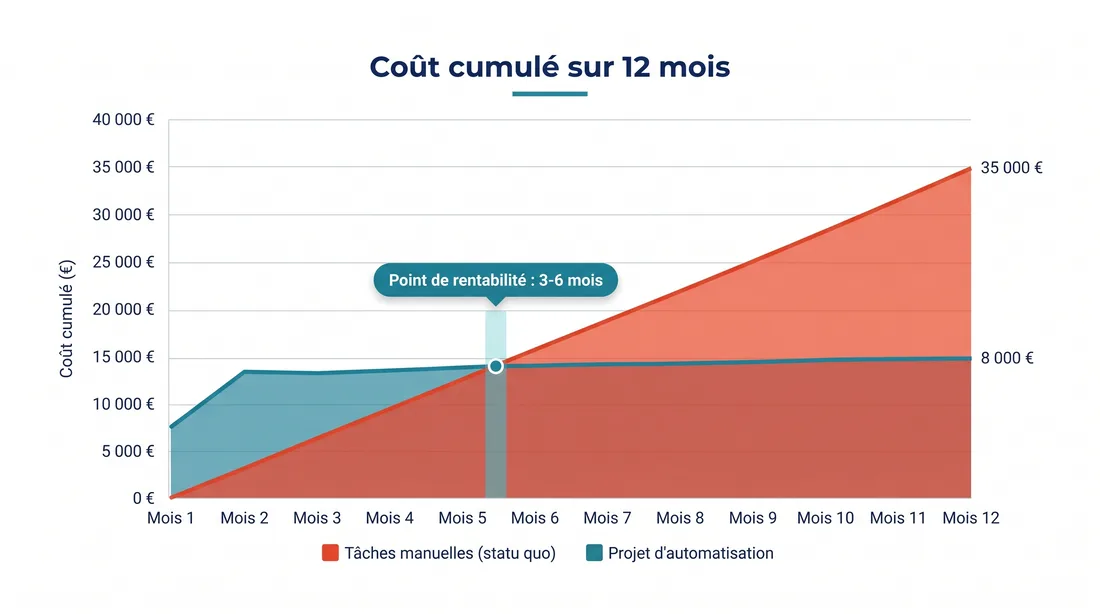
An automation starts at €2,000 for one process and ranges from €8,000 to €25,000 for a multi-department transformation. ROI is typically reached in 3 to 6 months.
Quick Win
From €2,000
1-2 simple processes
3-5 days
Automation of a key process: invoicing, reminders, notifications. Ideal for testing and proving ROI.
- Target process audit
- Complete automation
- Team training
- 30 days of support
Transformation
€8,000 – €25,000
3-5 processes
3-6 weeks
Multi-department automation with AI. Connects your main tools and eliminates data silos.
- Complete process audit
- Custom AI architecture
- Multi-tool integrations
- Training + documentation
- 90 days of support
Full Transformation
Custom quote
Entire company
2-3 months
Complete digital transformation. All departments connected, AI integrated into critical processes.
- Global AI strategy
- Unlimited automations
- Autonomous AI agents
- Intensive training
- Priority support 12 months
Et après ? Aucune maintenance obligatoire.
Beaucoup de prestataires vendent l'automatisation avec un abonnement de maintenance imposé. Pas nous : vous êtes propriétaire du système que nous livrons, code compris. Vous pouvez l'exploiter, le faire évoluer en interne ou confier la suite à qui vous voulez.
Dans les faits, 100 % de nos clients choisissent une maintenance évolutive. Elle représente 1 à 15 jours par mois selon le périmètre. Aucun contrat ne l'impose. Un premier processus automatisé en appelle souvent un second.
All our projects start with a free 30-minute audit. ROI is typically achieved in 3-6 months.
Describe your project — quote within 24 hours
Personal reply from an expert, no commitment.
They trust us
Projects delivered by our team — JAIKIN × Azinove Group
« Victor from JAIKIN took over our old website content, enriched it with relevant material without taking up my time — and we are climbing the rankings. Inquiries keep coming in. »
David K.
Managing Director, Kappeler — illuminated signage (since 1962)
« JAIKIN has been our technology delivery partner from the very first execution phase. »
Tomislav Lang
CEO & Co-founder, Flyvbird — aviation
« Beyond the quality of the development itself, we valued their expertise on strategic AI and Data topics, with data sovereignty addressed from day one. What truly sets Jaikin apart is their commitment well beyond project delivery. We recommend Jaikin without hesitation. »
Ardo
SaaS — legal sector
JAIKIN at a glance
What defines us, in four points.
- Focus
- AI & operational automation consultancy for industrial SMEs and mid-market companies — results-driven, with fast production rollout.
- Compliance
- Privacy-first AI: built GDPR & AI Act compliant, data hosted in Europe, human oversight at every step.
- Method & ROI
- Standard approach: ROI-focused pilots in 3 to 6 months, with success metrics defined from the scoping stage.
- Integration
- Odoo integrator, AI and no-code automation for industrial information systems — including existing (brownfield) environments.

Victor Gless-Krumhorn
Founder & AI Consultant — JAIKIN
AI implementation and automation expert for SMBs and mid-market companies. Works with businesses across France, Germany and Switzerland, from process mapping to production rollout.
Frequently Asked Questions About AI Automation
Most of our projects are implemented in 4-8 weeks. We start with a 1-2 week POC (Proof of Concept) to validate the solution on a real use case before full deployment. Simple automations (email reminders, notifications) can be operational in 3-5 days.
It's our top priority. We use infrastructure hosted in France/EU (OVH, Scaleway), encrypted connections (TLS 1.3), and we never store your sensitive data. For clients with strict requirements, we deploy self-hosted orchestration on your own servers. GDPR and AI Act compliance built in from design.
We measure 4 key indicators: (1) Time saved in hours/week, (2) Error reduction in %, (3) Processing times before/after, (4) Cost per process. The dashboard is included in every project. Most of our clients break even within 3 to 6 months.
An AI automation agency designs and deploys systems that take over your repetitive tasks using artificial intelligence: business workflows, AI agents connected to your tools (email, CRM, ERP), document processing, reporting. Unlike a software vendor, it starts from YOUR processes to automate what costs you the most time, and stays technology-neutral. JAIKIN is an AI automation agency based in France that builds proprietary platforms — your data, your flows, no vendor lock-in.
Four criteria: 1) verifiable quantified results (hours saved, ROI), not promises; 2) real technical expertise (LLMs, RAG, orchestration, integration with your information system), not just consulting; 3) GDPR and AI Act compliance built in from the design stage; 4) ownership — prefer a platform you own over a per-seat subscription that locks you in. JAIKIN ticks all four, with a free first audit to validate the value before investing.
The cost depends on scope. A first targeted automation — a single process such as follow-ups or email sorting — represents an investment of a few thousand euros, while a complete business platform integrated with your information system is priced according to the number of flows and connections. Unlike a per-user SaaS subscription, the development is paid once and the platform belongs to you. We always start with a free 30-minute audit to price your case precisely and estimate the ROI.
Ready to automate your processes with AI?
Plan your AI strategy (free)Related Services
Discover our other solutions for your business