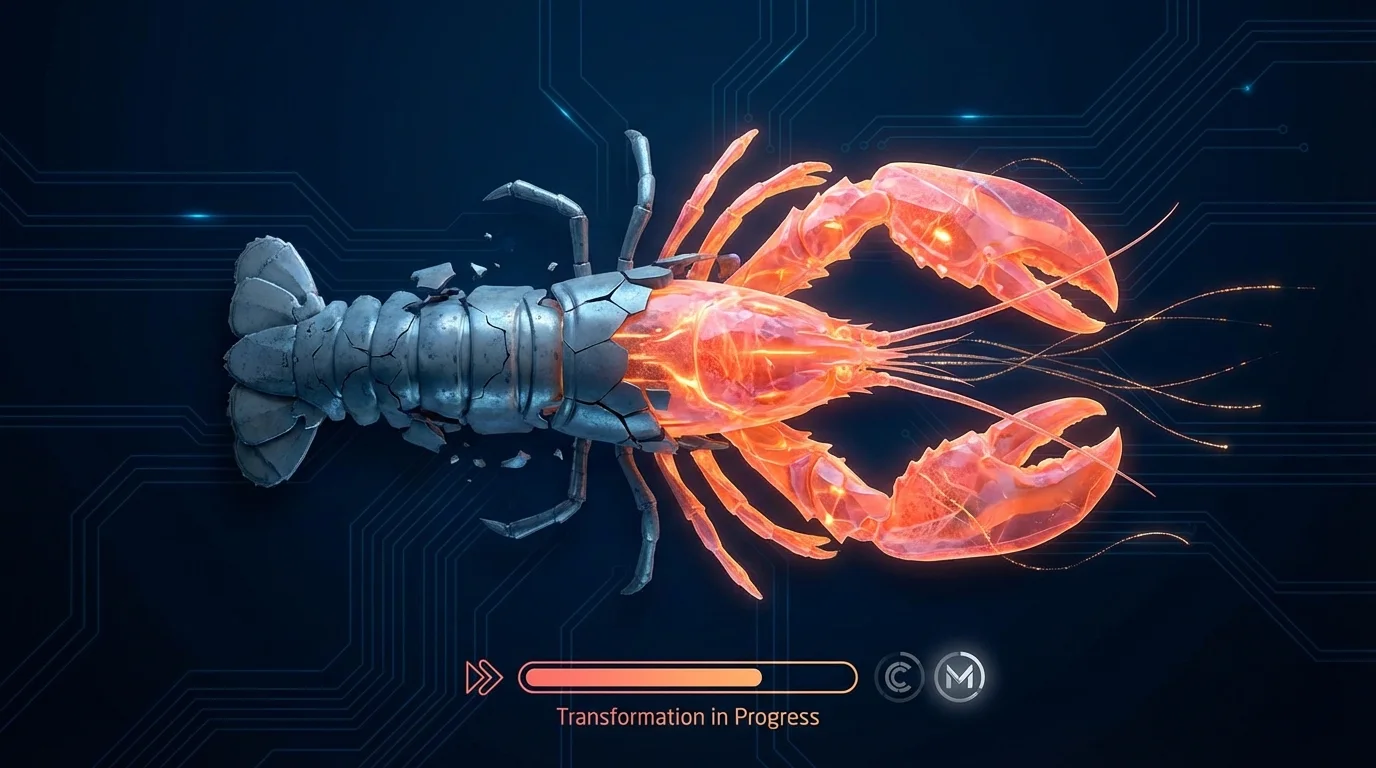
ClawdBot, the open-source AI assistant that amassed over 60,000 stars on GitHub, was forced to change its name in January 2026 following a request from Anthropic. Now rebranded as MoltBot, the project raises fundamental questions about intellectual property in the AI ecosystem, but also about what a self-hosted AI assistant truly represents. Full analysis.
In this article
- 1. Who is Peter Steinberger, the creator of ClawdBot?
- 2. ClawdBot: the concept of an AI assistant you truly own
- 3. The conflict with Anthropic: timeline and stakes
- 4. From ClawdBot to MoltBot: a symbolic molt
- 5. What MoltBot truly brings, beyond the price
- 6. Technical architecture: how it works
- 7. Limitations and risks to be aware of
- 8. Impact on the open-source AI ecosystem
- 9. Conclusion: should you adopt MoltBot?
1. Who is Peter Steinberger, the creator of ClawdBot?
Behind ClawdBot (now MoltBot) is Peter Steinberger, known in the developer community as @steipete. This Austrian developer is no stranger to the tech world. He is the founder of PSPDFKit (now renamed Nutrient), a PDF technology company used by millions of applications worldwide.
Steinberger is recognized as an expert in the Apple ecosystem. An active contributor to the iOS community for over a decade, he built PSPDFKit into a profitable company without raising venture capital — a rare profile in European tech. His expertise in native development and software architecture gives him a technical credibility that many open-source AI project creators lack.
Peter Steinberger at a glance
- Founder of PSPDFKit/Nutrient — PDF SDK used in thousands of applications
- Renowned iOS developer — active contributor to the Apple ecosystem since 2010+
- Bootstrapped entrepreneur — profitable company without venture capital
- 60,000+ GitHub stars on ClawdBot/MoltBot in just a few weeks
It was as a power user of Anthropic's Claude that Steinberger conceived ClawdBot. Frustrated by the limitations of traditional conversational interfaces, he wanted an AI assistant capable of retaining context across sessions, executing actions on his computer, and communicating through his usual messaging channels. The project was born out of this personal need, before finding massive resonance in the community.
2. ClawdBot: the concept of an AI assistant you truly own
The founding idea behind ClawdBot is simple yet powerful: a self-hosted AI assistant that you fully control. Unlike cloud chatbots such as ChatGPT or Claude, ClawdBot runs on your own infrastructure. You own your data, you choose your AI model, and you decide what the assistant can and cannot do.
The founding principles of ClawdBot/MoltBot
-
Self-hosted: the assistant runs on your server, not a third party's. Your conversations never leave your infrastructure (except for LLM API calls).
-
Persistent memory: unlike ChatGPT which "forgets" between sessions, MoltBot remembers everything — your preferences, ongoing projects, habits.
-
Proactive: MoltBot doesn't just respond. It can send morning briefings, project alerts, or contextual reminders.
-
Multi-platform: access your assistant via WhatsApp, Telegram, Slack, iMessage, or a dedicated web interface.
The name "ClawdBot" was an obvious nod to Claude, the Anthropic model that Steinberger used as the primary backend. The project was initially designed as a smart wrapper around the Claude API, adding the missing layers: memory, action execution, and multi-channel communication.
3. The conflict with Anthropic: timeline and stakes
On January 27, 2026, Peter Steinberger publicly announced that Anthropic had forced him to rename his project. The name "ClawdBot" — a play on "Claude" with a lobster's claw — was deemed too close to Anthropic's registered trademark "Claude."
Conflict timeline
ClawdBot launches on GitHub. The project quickly takes off and accumulates thousands of stars.
ClawdBot surpasses 60,000 GitHub stars. The visibility catches Anthropic's attention.
Anthropic contacts Steinberger with a name change request citing trademark concerns.
Steinberger announces the rebrand: ClawdBot becomes MoltBot. The new domain is molt.bot.
Steinberger publicly expressed his frustration, revealing that he had first proposed the name "Clawbot" (without the "d"), but Anthropic had also rejected that alternative. Anthropic's position was clear: any variation phonetically close to "Claude" constituted a risk to their brand.
Why this decision divided the community
The tech community's reaction was strong. On one hand, many considered Anthropic's request excessive — ClawdBot being an open-source project that generated Claude API usage (and therefore revenue for Anthropic). On the other hand, intellectual property specialists pointed out that companies are legally obligated to defend their trademarks or risk losing them.
Arguments against Anthropic
- • ClawdBot was increasing Claude API usage
- • The project was clearly distinct from the Claude product
- • Bad signal sent to the open-source ecosystem
- • Peter Steinberger is a recognized contributor
Arguments in favor of Anthropic
- • Legal obligation to defend the trademark
- • Risk of user confusion
- • "Clawd" is phonetically identical to "Claude"
- • Dangerous precedent if left undefended
An unexpected side effect of the rebrand: crypto scammers quickly created fake "ClawdBot" and "MoltBot" tokens to capitalize on the buzz, forcing Steinberger to issue repeated warnings on his social media. A reminder that visibility in the AI ecosystem also attracts bad actors.
4. From ClawdBot to MoltBot: a symbolic molt
The choice of the new name is far from random. "Molt" refers to the process by which a lobster (the project's original logo) sheds its shell to grow. It's a carefully chosen metaphor: the project changes its name, but its essence remains the same.
What changed with the rebrand
What changed
- • Name: ClawdBot → MoltBot
- • Domain: clawdbot.com → molt.bot
- • GitHub repository renamed
- • Logo and branding updated
What stayed the same
- • Identical source code (MIT license)
- • All features preserved
- • Same team, same vision
- • The lobster stays in the branding
The plugin marketplace, originally named "ClawdHub," was rebranded to "MoltHub". All documentation and references have been updated, and the old URLs redirect to the new addresses. For existing users, the transition is seamless.
5. What MoltBot truly brings, beyond the price
The most cited argument for MoltBot is cost: "it's free, open-source, you just pay for API tokens". That's true — API costs range from 10 to 150 EUR per month depending on usage, compared to 20-200 EUR/month for Claude Pro or ChatGPT Plus subscriptions. But reducing MoltBot to a price question would be missing the point entirely.
5.1 Persistent memory: the real game-changer
When you chat with ChatGPT or Claude, every conversation starts (almost) from scratch. You have to re-explain your context, preferences, and projects. MoltBot fundamentally changes this dynamic.
Concrete examples of persistent memory
-
Business context: MoltBot knows you're marketing director at X, your stack is Y, your KPIs are Z — without re-explaining.
-
Project tracking: "Where does Project Alpha stand?" → MoltBot knows what you're talking about, the history, blockers, and next steps.
-
Communication preferences: it knows you prefer concise answers in the morning and detailed ones in the afternoon.
5.2 Action execution: an assistant that acts
MoltBot isn't limited to conversation. It can execute concrete actions on your system:
System access
- • Execute terminal commands
- • Read and modify files
- • Browse the web
- • Control smart home devices
Automations
- • Personalized morning briefings
- • Proactive contextual alerts
- • Scheduled automatic scripts
- • Metrics monitoring
5.3 Data sovereignty
For companies subject to GDPR, sector-specific regulations (healthcare, finance, defense), or simply concerned about confidentiality, MoltBot offers a structural advantage: your conversational data stays on your infrastructure. Only LLM queries pass through the provider's API — and you can even use local models via Ollama for complete sovereignty.
5.4 Model independence
Despite its origins tied to Claude, MoltBot is agnostic in terms of AI backend. You can use:
- Claude (Anthropic) — the default backend, optimal for complex reasoning
- GPT-4o / GPT-4.5 (OpenAI) — performant alternative, large ecosystem
- Local models via Ollama — Llama, Mistral, Gemma... for complete sovereignty
- Google Gemini — recent integration, good value for money
6. Technical architecture: how it works
MoltBot is built on a modular architecture designed for extensibility. Here are the main components:
MoltBot tech stack
Core Engine
The central engine manages the conversational loop, contextual memory (stored locally in SQLite or PostgreSQL), and plugin orchestration. It exposes a REST API for integrations.
Messaging Gateway
A unified connector system for WhatsApp (via the Business API or bridges), Telegram (Bot API), Slack (Webhooks + Events API), iMessage (via AppleScript on macOS), and a built-in web interface.
Plugin System (MoltHub)
An extensible architecture for adding capabilities: home automation control, calendar access, GitHub integration, server monitoring, etc. Plugins are shared via MoltHub, the community marketplace.
LLM Layer
An AI backend abstraction layer enabling switching between providers. Native support for Claude, GPT, Gemini, and local models via Ollama. Automatic context and token window management.
Installation is done via Docker in just a few minutes. The project provides a pre-configured docker-compose.yml
that launches the core, database, and web interface. For advanced users,
each component can be deployed independently.
7. Limitations and risks to be aware of
MoltBot is not without flaws. Before adopting it, it's important to understand its current limitations.
Points of concern
-
Security: security researchers identified vulnerabilities in early versions, including API keys exposed in logs. Securing an AI agent with system access is a major challenge.
-
Technical skills required: installation and maintenance require DevOps skills. This is not a turnkey product for non-technical users.
-
API costs not included: the software is free, but API calls (Claude, GPT, etc.) generate costs from 10 to 150 EUR/month depending on usage. A heavy user can exceed 200 EUR/month.
-
Execution risk: giving an LLM access to your terminal and files carries inherent risks. A bad instruction or hallucination can have real consequences on your system.
These limitations are not deal-breakers, but they mean MoltBot is currently aimed primarily at a technical audience — developers, DevOps engineers, CTOs — capable of understanding and mitigating these risks.
8. Impact on the open-source AI ecosystem
Beyond the renaming anecdote, the ClawdBot/MoltBot affair reveals structural tensions in the AI ecosystem. Model providers (Anthropic, OpenAI, Google) build closed platforms, while a growing community wants to regain control of its AI tools.
What the ClawdBot affair reveals about AI in 2026
-
Self-hosted AI is a lasting trend: 60,000 stars in a few weeks demonstrate real demand for alternatives to cloud chatbots.
-
Brand vs. ecosystem: AI companies must find a balance between brand protection and supporting developers who enrich their ecosystem.
-
Agentic AI is the future: MoltBot foreshadows a new generation of AI assistants capable of acting, not just conversing.
MoltBot's success is part of a broader movement: agentic AI. Projects like Auto-GPT, CrewAI, or LangGraph explore the same idea — AIs capable of executing complex tasks autonomously. MoltBot stands out through its end-user-centric approach rather than developer-centric, with a multi-channel interface accessible for daily use.
9. Conclusion: should you adopt MoltBot?
MoltBot isn't just "cheaper Claude." It's a different vision of the AI assistant: self-hosted, persistent, proactive, and extensible. The conflict with Anthropic, far from weakening the project, gave it considerable media visibility and strengthened the community around a cause: open-source and sovereign AI.
Is MoltBot right for you?
Adopt if:
- • You have technical skills (Docker, CLI)
- • Data confidentiality is critical
- • You want an assistant that learns from you
- • You use multiple messaging channels
Wait if:
- • You're looking for a turnkey solution
- • You don't have a server available
- • Your usage is occasional
- • Your system security is sensitive
For businesses, MoltBot opens an interesting path: deploying internal AI assistants, connected to your business tools, with persistent memory of your organizational context. This is exactly the type of AI implementation we support at JAIKIN — if you'd like to explore the topic, get in touch.
Sources and references
- • Official MoltBot GitHub repository (formerly ClawdBot)
- • Peter Steinberger's (@steipete) rebrand announcement — January 27, 2026
- • Official MoltBot documentation — molt.bot
- • Community discussions on Hacker News and Reddit about the Anthropic conflict
Nous intervenons dans toute la France
Prêt à intégrer l'IA dans vos processus ?
Audit IA gratuit. Nous identifions les cas d'usage les plus pertinents pour votre activité et vous accompagnons de A à Z.